✅ When is it very necessary to have your own brand
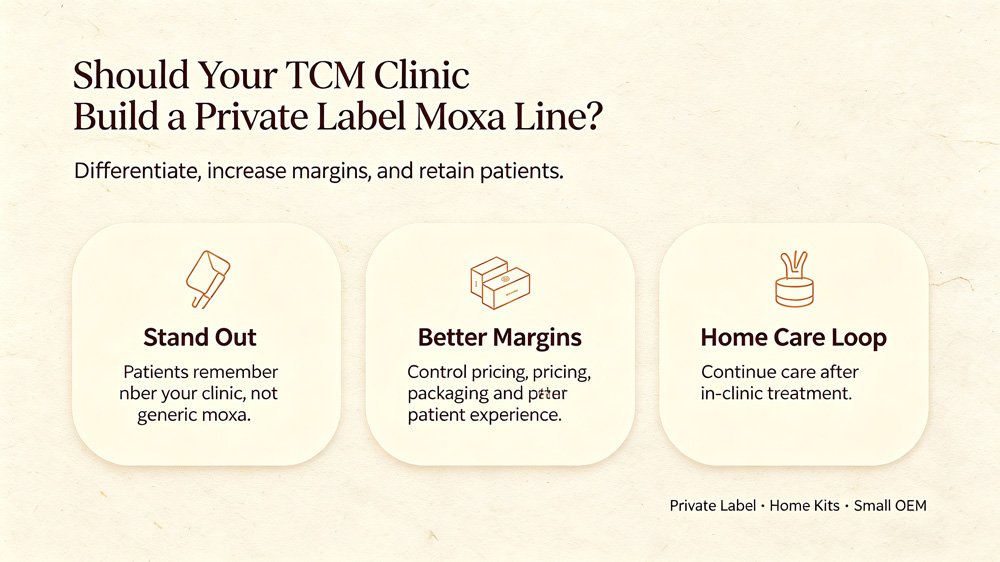
1. Solve the problem of industry homogenization and internal competition, and establish a unique identity for clinics
The vast majority of moxibustion clinics purchase generic moxa sticks and moxibustion boxes from external suppliers. Customers can easily find similar low-priced products online. After the treatment, they purchase consumables online. Clinics only earn a one-time manual service fee and cannot retain customer loyalty.
Printing your own brand consumables with your salon name and conditioning philosophy allows customers to take them home and use them every time, providing continuous brand exposure and distinguishing yourself from ordinary health salons in the vicinity.
Example: Two community moxibustion centers, Center A uses commonly available loose moxa sticks on the market; Center B provides customers with the [XX Traditional Chinese Medicine Center Home Moxibustion Kit] (featuring its own logo moxa cones + portable moxibuster + customized maintenance manual provided by the center). When customers use it at home, they will constantly think of Center B, increasing the likelihood of repurchasing and referrals.
2. Increase gross profit and gain pricing autonomy
Middlemen add multiple layers of markups, resulting in thin profits for finished products and consumables; by removing the middlemen through OEM, the gross profit margin can be higher for the same quality. At the same time, you can set prices based on the clinic’s positioning, without engaging in cut-throat price competition with low-priced products across the internet.
Example: The purchase price of outsourced brand three-year-aged moxa cones is 0.8 yuan per piece, with a retail price of 1.2 yuan; for small-batch OEM moxa cones of the same style, the cost can be reduced to 0.55 yuan per piece, and the retail price can be controlled independently, significantly increasing profit margins.
3. Break through the complete service loop of “in-house conditioning + home maintenance”
Moxibustion conditioning emphasizes continuous maintenance. After customers leave the store, the absence of supporting tools can easily interrupt the conditioning process. Self-owned consumables can be delivered as a supporting home solution, enhancing the conditioning effect and simultaneously increasing secondary revenue, turning one-time in-store customers into long-term private customers.
Example: After the customer completes the spleen and stomach moxibustion treatment, the doctor pairs it with the clinic’s own brand home-use moxa cone set and guides the customer to consolidate the treatment at home. This not only enhances the diagnostic and treatment services but also generates additional product sales revenue, thereby increasing the customer’s lifetime value.
4. Possess long-term expansion potential (chain operations, external supply, foreign trade)
If there are plans to open branches, develop supply for peers, or engage in cross-border foreign trade in the future, having one’s own brand serves as the foundation. Unified quality and packaging facilitate standardized replication; without one’s own trademark, it is difficult to engage in large-scale external cooperation.
❌ Under which circumstances is it temporarily unnecessary to establish a private brand
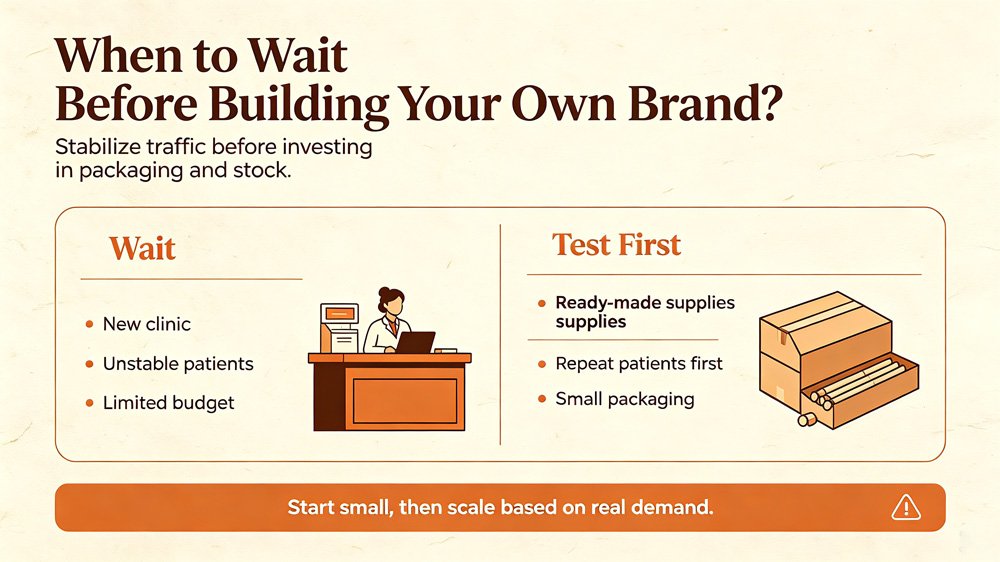
- Less than half a year since opening, unstable customer flow, and tight finances
OEM involves packaging design, sample making, and initial inventory costs. If the customer base is small, it is easy to cause overstocking and occupation of cash flow. It is advisable to prioritize store technology and customer acquisition, and only initiate OEM after securing a stable customer base. - Focusing solely on short-term traffic attraction and low-profit high-volume sales, without long-term brand planning
I only intend to attract customers at a low price for single-session treatments, and have no plans to offer membership or home repurchase products. It would be more convenient to directly wholesale finished consumables, eliminating the need for design, inventory, and quality control management efforts. - Lack of a stable supply chain and ignorance of compliance requirements
Moxa products involve raw material qualifications, testing reports, and compliance with promotional regulations. Blindly affixing labels without familiarizing oneself with industry rules can easily lead to risks such as promotional violations and unstable raw material quality.
⚠️ Key points to avoid pitfalls when creating your own brand (low-cost trial and error approach)
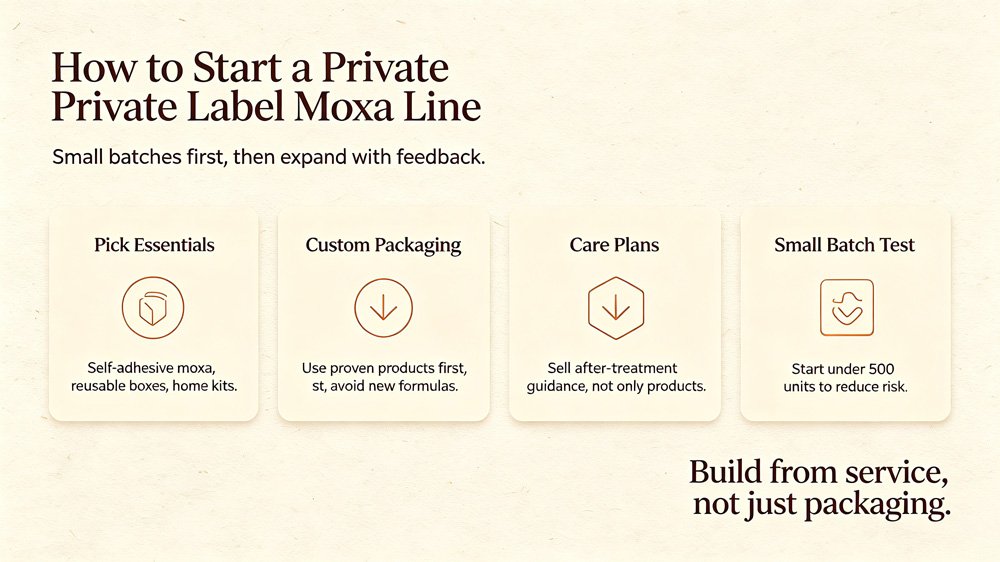
Instead of starting with a full set of customization in large quantities, we recommend a small-batch OEM light testing mode:
- First, select 2-3 essential products: self-adhesive moxa cones, household wooden moxibuster, and simple home kit. Order at least 500 sets to test market feedback and reduce inventory risk;
- Prioritize customizing packaging and printing logos only, and engage in OEM for mature public-version products, without blindly modifying formulas (formula customization is costly and time-consuming);
- Improve qualifications: Require factories to provide raw material testing and quality inspection reports, avoid using medical efficacy language in promotional texts, and operate in compliance with regulations;
- Supporting service script: Selling proprietary consumables is not just about selling products. It involves bundling with physicians’ diagnostic and maintenance plans to highlight professional value, rather than just selling daily necessities.
In a nutshell: Not all clinics must pursue it, but if you aim to establish differentiation, boost profits, and retain customers in the medium to long term, it’s highly worthwhile to invest in your own brand; for new or small clinics, it’s advisable to start with small-scale trial orders rather than making a heavy investment.